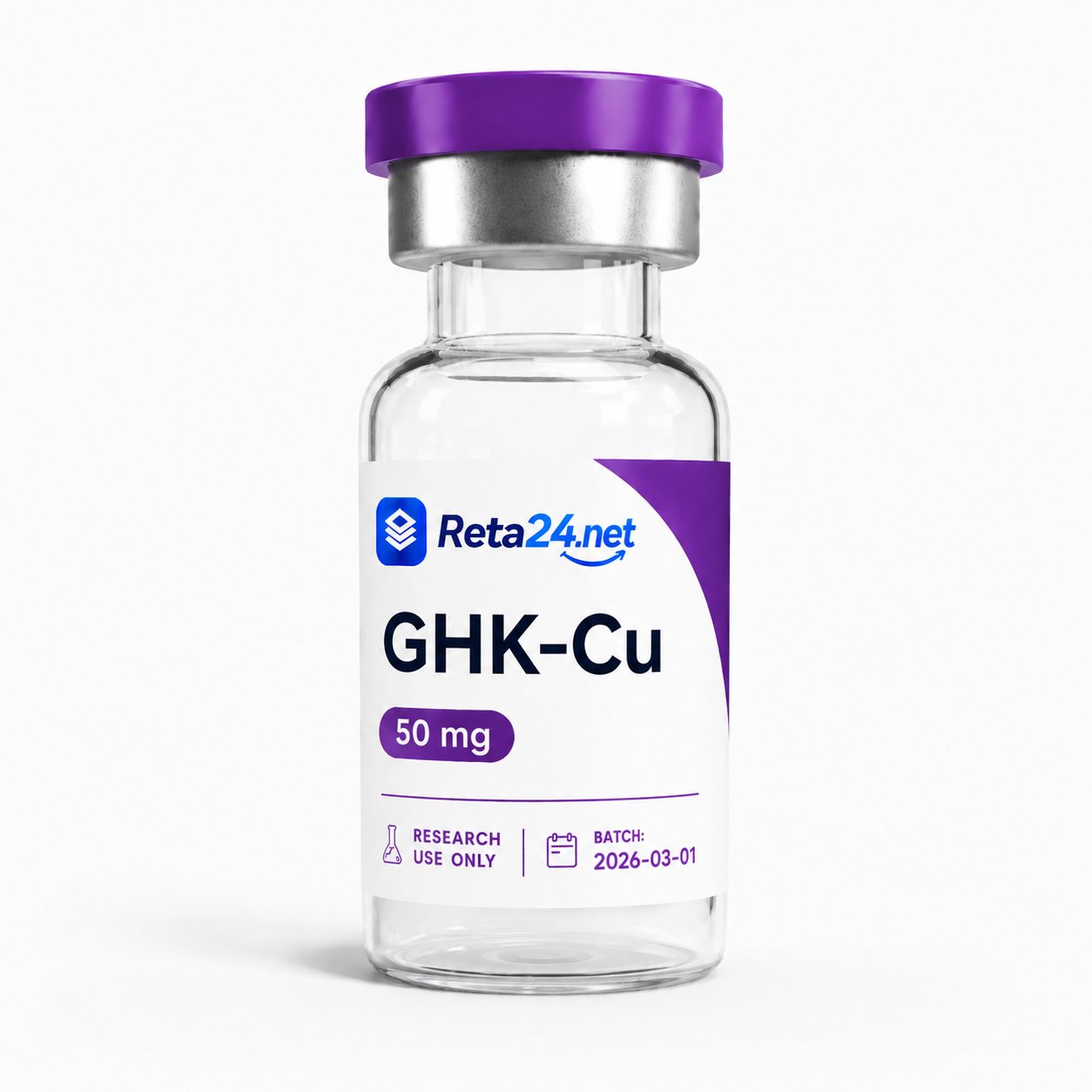
GHK-Cu – Copper Peptide for Regenerative Research
GHK-Cu is a naturally occurring tripeptide-copper complex made up of the three amino acids glycine, histidine, and lysine, coordinating a copper(II) ion (Cu²⁺). Biochemist Dr. Loren Pickart first isolated this molecule from human blood plasma in 1973, laying the groundwork for more than five decades of intensive research.
In the human body, GHK-Cu occurs in blood plasma, saliva, and urine. Plasma levels decline markedly with age — from around 200 ng/ml at age 20 to roughly 80 ng/ml at age 60.
Scientific Background
GHK-Cu is among the most extensively studied peptides in regenerative research. Current data analyses show that GHK-Cu modulates the expression of more than 4,000 human genes — including genes involved in collagen synthesis, wound healing, antioxidant defense, and inflammation regulation.
Key Mechanisms of Action (in vitro / in vivo, preclinical)
- Collagen & Elastin: Stimulation of fibroblast activity — studies report a doubling of collagen production in cell cultures and up to a 70 % increase in skin elasticity after 12 weeks
- Wound Healing: Activation of TGF-β signaling pathways, promotion of angiogenesis and fibroblast migration
- Genomic Reprogramming: GHK-Cu can reset the gene expression profile of aged skin cells toward patterns typical of younger cells
- Antioxidant Activity: Increases glutathione and ascorbic acid levels; inhibits NF-κB
- Tissue Remodeling: Activation of matrix metalloproteinases (MMPs) for tissue repair and collagen remodeling
Specification
| Sequence | Gly-His-Lys · Cu²⁺ |
| Molecular Weight | 340.38 g/mol |
| CAS Number | 89030-95-5 |
| Purity | ≥ 98 % (HPLC-verified) |
| Form | Lyophilized Powder |
| Storage | Cool, dry, and protected from light; after reconstitution store at 2–8 °C |
Reconstitution: Example Calculation
For a working concentration of 10 mg/ml, reconstitute the 50 mg vial with 5 ml, or the 100 mg vial with 10 ml, of sterile bacteriostatic water (BAC water). Inject the water slowly along the inside wall of the vial and swirl gently rather than shaking.
Frequently Asked Questions
Which pack size suits which purpose?
The 50 mg size suits compact research runs; the 100 mg size suits more extensive studies with multiple data points without re-reconstituting.
Is copper peptide more sensitive to storage than other peptides?
GHK-Cu should be stored like other lyophilised peptides at -20°C long-term; the copper coordination itself does not add extra storage sensitivity.
Quality Assurance
Every production batch goes through independent dual verification: HPLC analysis to determine purity, and LC-MS analysis to unambiguously confirm molecular mass and correct peptide sequence. Only after passing both checks is a batch released, shipped with a batch-specific Certificate of Analysis (COA).
Reviews
There are no reviews yet.