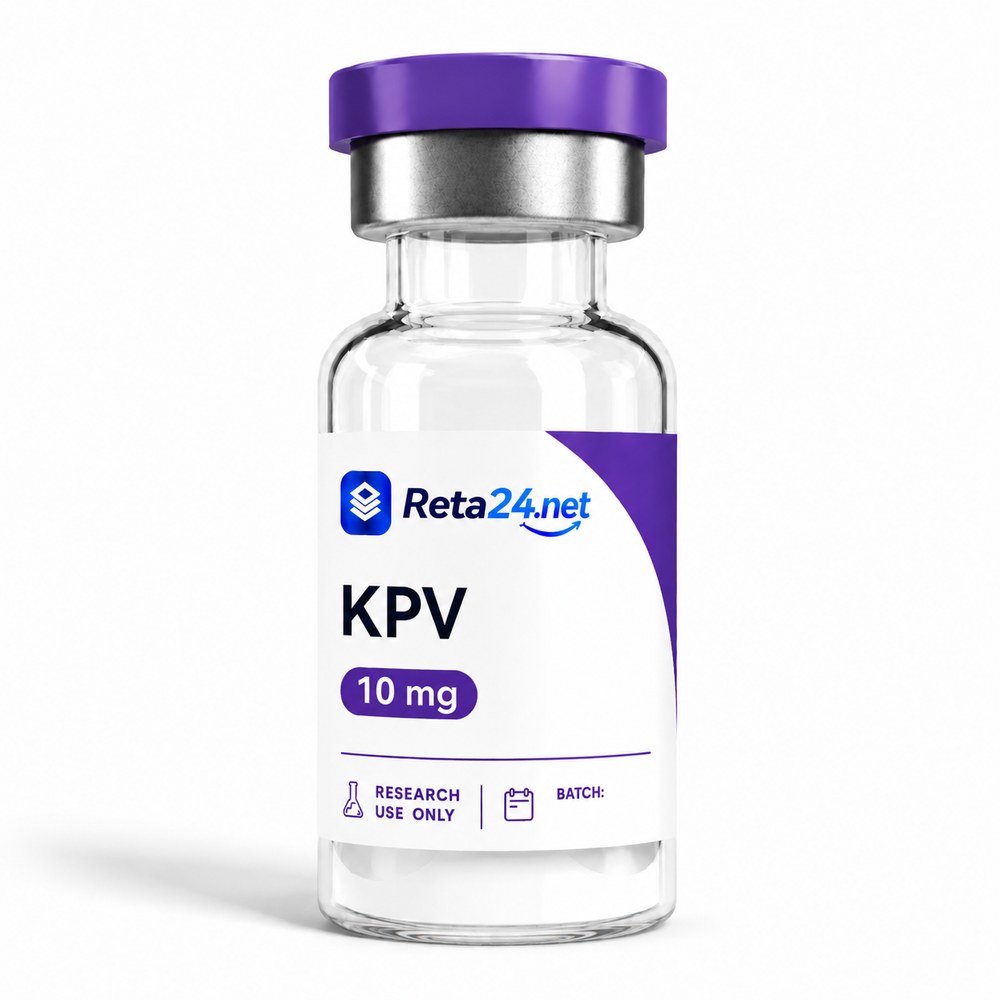
KPV 10mg – Tripeptide for Inflammation Research
KPV is a naturally occurring tripeptide corresponding to the C-terminal fragment (position 11–13) of the alpha-MSH molecule. First described in 1989 by Hiltz and Lipton, it is among the best-studied melanocortin-receptor-independent peptide fragments with anti-inflammatory properties in preclinical research.
This 10mg vial is suited for research into cellular inflammatory signaling pathways, intestinal barrier models, and tripeptide transport mechanisms.
Mechanism of Action
Unlike the full alpha-MSH molecule, KPV does not bind to melanocortin receptors — the core sequence required for receptor binding (His-Phe-Arg-Trp) is entirely absent from the tripeptide. Instead, KPV is taken up in the intestinal epithelium via the di-/tripeptide transporter PepT1 and inhibits NF-κB and MAPK signaling pathways intracellularly, among other things by stabilizing IκB-α and blocking p65/RelA nuclear translocation.
Technical Specifications
| Property | Details |
|---|---|
| Product Name | KPV (Lys-Pro-Val) |
| CAS Number | 67727-97-3 |
| Quantity | 10mg |
| Form | Lyophilized Powder |
| Sequence | H-Lys-Pro-Val-OH |
| Molecular Formula | C₁₆H₃₀N₄O₄ |
| Molecular Weight | 342.44 g/mol |
| Purity | ≥98.9% (HPLC) |
| Analysis | HPLC / LC-MS |
| Storage | 2–8 °C |
Storage: At −20 °C (long-term); after reconstitution store at 4 °C and use promptly. Protect from light and moisture.
Source: Hiltz ME, Lipton JM, “Anti-inflammatory activity of a COOH-terminal fragment of the neuropeptide α-MSH”, FASEB Journal, 1989; Dalmasso G et al., “PepT1-Mediated Tripeptide KPV Uptake Reduces Intestinal Inflammation”, Gastroenterology, 2008
Disclaimer: Not intended for human or veterinary use. For laboratory research purposes only. Not for diagnostic or therapeutic use.
Reconstitution: Example Calculation
For a working concentration of 10 mg/ml, reconstitute the 10 mg vial with 1 ml of sterile bacteriostatic water (BAC water). Inject the water slowly along the inside wall of the vial and swirl gently rather than shaking.
Frequently Asked Questions
Does KPV act through the melanocortin receptor?
No — unlike many alpha-MSH fragments, KPV shows anti-inflammatory effects in preclinical research independent of melanocortin receptor binding.
How long has KPV been studied?
KPV was first described in 1989 by Hiltz and Lipton and remains one of the best-documented alpha-MSH fragments in inflammation research.
Quality Assurance
Every production batch goes through independent dual verification: HPLC analysis to determine purity, and LC-MS analysis to unambiguously confirm molecular mass and correct peptide sequence. Only after passing both checks is a batch released, shipped with a batch-specific Certificate of Analysis (COA).
Reviews
There are no reviews yet.