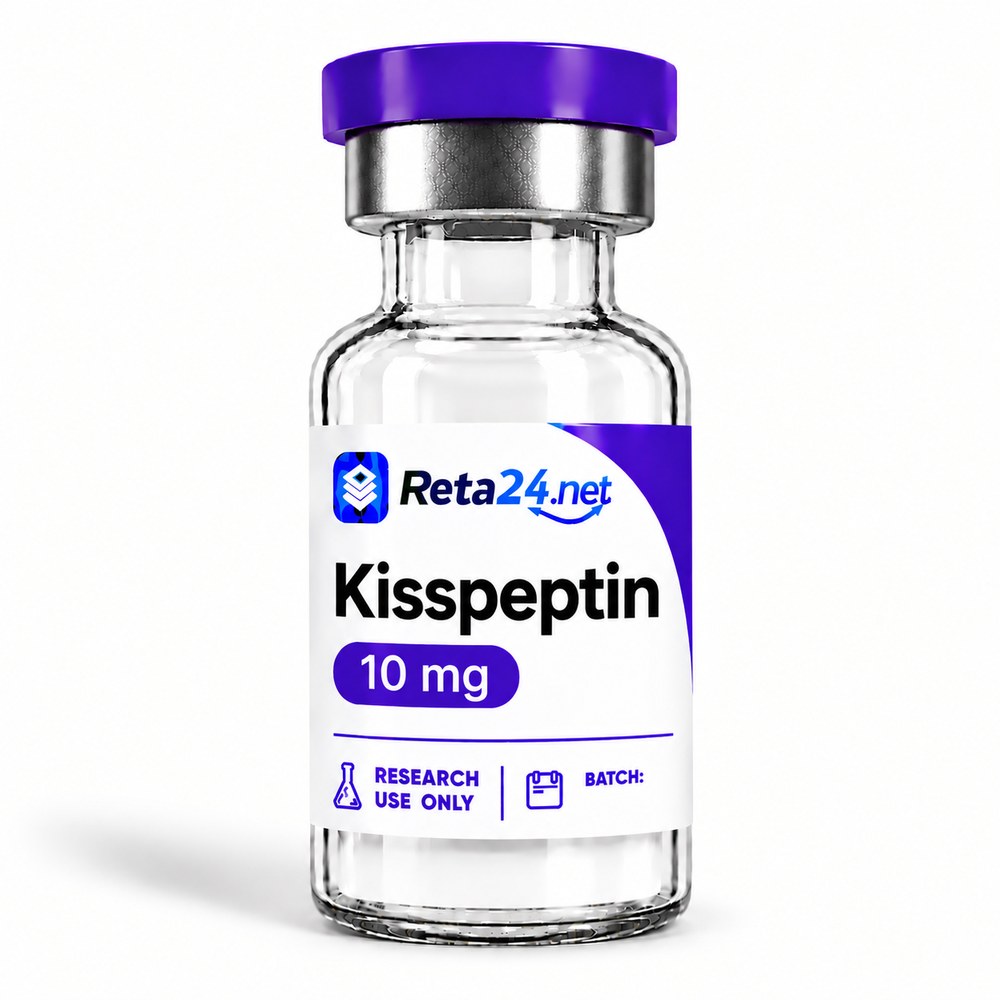
Kisspeptin 10mg – Key regulator of the reproductive axis
Kisspeptin-10 is the shortest bioactive fragment (amino acids 45–54) of the metastin protein encoded by the KISS1 gene. The KISS1 gene was discovered in 1996 at Pennsylvania State University in Hershey, Pennsylvania—hence the name. Originally described as a metastasis suppressor, kisspeptin has been considered a central pacemaker of the hypothalamic-pituitary-gonadal axis since the discovery of its receptor GPR54/KISS1R (Seminara et al., 2003).
This 10mg vial is suitable for research approaches related to GnRH pulsatility, puberty induction and reproductive endocrinology.
Mechanism of action
Kisspeptin binds to the G-protein-coupled receptor GPR54 (KISS1R) on GnRH-producing neurons in the hypothalamus, triggering the pulsatile release of gonadotropin-releasing hormone (GnRH). This initiates the downstream release of LH and FSH from the pituitary gland—a mechanism whose disruption (e.g., by KISS1R mutations) is associated with hypogonadotropic hypogonadism.
Technical specifications
| Characteristic | Details |
|---|---|
| Product name | Kisspeptin-10 (human) |
| CAS number | 374675-21-5 |
| Crowd | 10mg |
| form | Lyophilized powder |
| molecular formula | C₆₃H₈₃N₁₇O₁₄ |
| Molecular weight | 1302.45 g/mol |
| purity | ≥98.9 % (HPLC) |
| analysis | HPLC / LC-MS |
| storage | 2–8 °C |
Storage: Store at −20 °C (long-term); after reconstitution at 4 °C, use within 2–4 weeks. Protect from light and moisture.
Source: Seminara SB et al., „The GPR54 Gene as a Regulator of Puberty,“ New England Journal of Medicine, 2003
Disclaimer: Not intended for human or veterinary use. For laboratory research purposes only. Not for diagnostic or therapeutic purposes.
Reconstitution: Example calculation
For a working concentration of 10 mg/ml, the 10 mg vial is reconstituted with 1 ml of sterile bacteriostatic water (BAC water). Slowly inject the water along the inside of the vial and gently swirl it instead of shaking.
Frequently Asked Questions
Why is Kisspeptin called that?
The name refers to the place where the KISS1 gene was discovered: Pennsylvania State University in Hershey, Pennsylvania — named in reference to the Hershey's Kiss chocolate located there, not to a pharmacological property.
What role does kisspeptin play in current research?
Besides its classic role in initiating puberty and regulating GnRH, kisspeptin is increasingly being studied in the context of sexual desire and limbic processing of sexual stimuli.
Quality assurance
Each production batch undergoes independent dual testing: HPLC analysis to determine purity and LC-MS analysis to definitively verify molecular mass and correct peptide sequence. Only after passing this test is a batch released.
Reviews
There are no reviews yet.