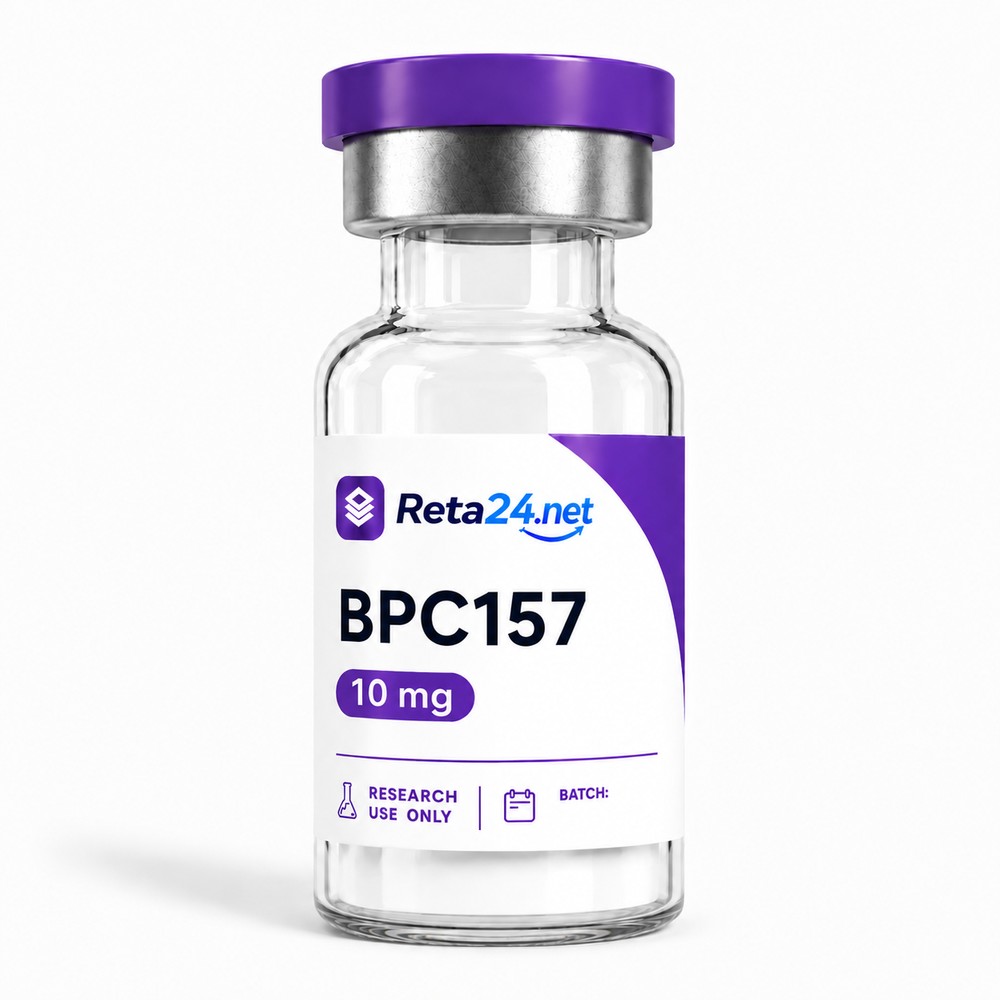
BPC-157 10mg – Pentadecapeptide from tissue regeneration research
BPC-157 („Body Protection Compound“) is a synthetic pentadecapeptide based on a partial sequence found in human gastric juice. It was discovered in the early 1990s by a team led by Predrag Sikirić at the University of Zagreb during research into cytoprotective effects in the gastrointestinal tract. Since then, it has been among the most studied peptides in the fields of angiogenesis and tissue regeneration research.
This 10mg vial is suitable for research approaches related to VEGFR2 signaling pathways, tendon and connective tissue models, and the gut-brain axis.
Mechanism of action
In preclinical models, BPC-157 promotes angiogenesis via activation of the VEGFR2-Akt-eNOS signaling pathway and modulation of the L-arginine-NO system. In tendon fibroblasts, a dose- and time-dependent upregulation of growth hormone receptor expression has also been described, which explains the interest in BPC-157 in tissue regeneration research.
Technical specifications
| Characteristic | Details |
|---|---|
| Product name | BPC-157 (pentadecapeptide) |
| CAS number | 137525-51-0 |
| Crowd | 10mg |
| form | Lyophilized powder |
| sequence | H-Gly-Glu-Pro-Pro-Pro-Gly-Lys-Pro-Ala-Asp-Asp-Ala-Gly-Leu-Val-OH |
| molecular formula | C₆₂H₉₈N₁₆O₂₂ |
| Molecular weight | 1419.55 g/mol |
| purity | ≥98.9 % (HPLC) |
| analysis | HPLC / LC-MS |
| storage | 2–8 °C |
Storage: Store at -20 °C (long-term); after reconstitution at 4 °C, use promptly. Protect from light and moisture.
Source: Sikirić P. et al., "A new gastric juice peptide, BPC. An overview of the stomach-stress-organoprotection hypothesis and beneficial effects of BPC", Journal of Physiology, Paris, 1993;87(5):313-327
Disclaimer: Not intended for human or veterinary use. For laboratory research purposes only. Not for diagnostic or therapeutic purposes.
Reconstitution: Example calculation
For a working concentration of 10 mg/ml, the 10 mg vial is reconstituted with 1 ml of sterile bacteriostatic water (BAC water). Slowly inject the water along the inside of the vial and gently swirl it instead of shaking.
Frequently Asked Questions
How was BPC-157 discovered?
As a partial sequence of a cytoprotective protein found in human gastric juice, isolated and described by a team led by Predrag Sikirić at the University of Zagreb.
Which application method is most commonly used in animal studies?
Predominantly administered subcutaneously or intraperitoneally, BPC-157 also shows stable efficacy in studies when administered orally.
Quality assurance
Each production batch undergoes independent dual testing: HPLC analysis to determine purity and LC-MS analysis to definitively verify molecular mass and correct peptide sequence. Only after passing this test is a batch released.
Reviews
There are no reviews yet.