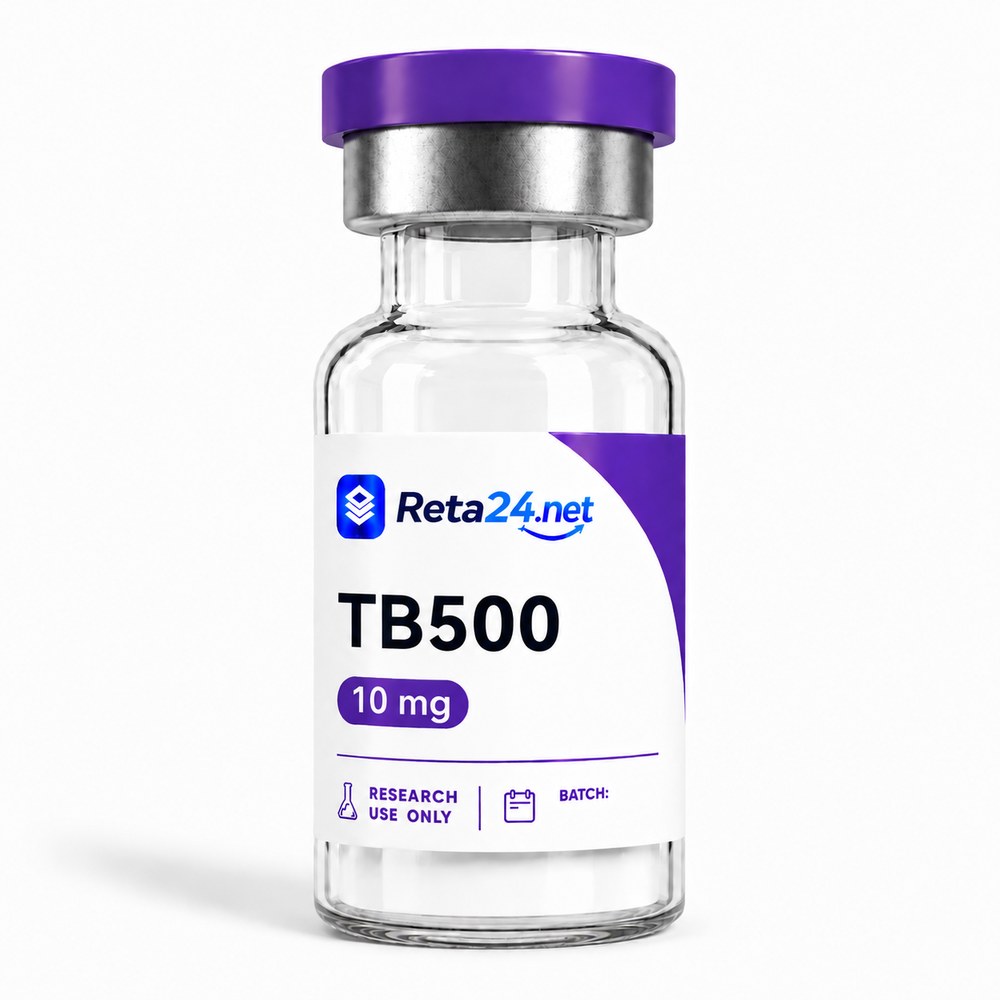
TB-500 10mg – Active Thymosin Beta-4 Fragment for Tissue Regeneration
TB-500 is the synthetic core fragment (amino acids 17–23) of thymosin beta-4, an endogenous regulatory protein for cell migration and tissue repair found in almost all cell types. This short 7-amino-acid fragment contains the active domain of the complete 43-amino-acid protein, which is responsible for actin binding.
This 10mg vial is suitable for research approaches related to cell migration, angiogenesis and tissue regeneration.
Mechanism of action
TB-500 binds to monomeric actin and thereby modulates cytoskeletal reorganization, promoting the migration of cells (including endothelial cells, keratinocytes, and fibroblasts) to damaged tissue. In addition, the promotion of angiogenesis via VEGF-mediated signaling pathways and an inflammation-modulating effect are discussed—structurally and functionally complementary to BPC-157, with which it is frequently studied in the research literature.
Technical specifications
| Characteristic | Details |
|---|---|
| Product name | TB-500 (Thymosin Beta-4 Fragment 17-23) |
| CAS number | 885340-08-9 |
| Crowd | 10mg |
| form | Lyophilized powder |
| molecular formula | C₃₉H₆₇N₉O₁₃ |
| Molecular weight | 877.99 g/mol |
| purity | ≥98.9 % (HPLC) |
| analysis | HPLC / LC-MS |
| storage | 2–8 °C |
Storage: Store at −20 °C (long-term); after reconstitution at 4 °C, use within 2–4 weeks. Protect from light and moisture.
Source: Goldstein AL, Hannappel E, Kleinman HK, „Thymosin β4: actin-sequestering protein moonlights to repair injured tissues,“ Trends in Molecular Medicine, 2005
Disclaimer: Not intended for human or veterinary use. For laboratory research purposes only. Not for diagnostic or therapeutic purposes.
Reconstitution: Example calculation
For a working concentration of 10 mg/ml, the 10 mg vial is reconstituted with 1 ml of sterile bacteriostatic water (BAC water). Slowly inject the water along the inside of the vial and gently swirl it instead of shaking.
Frequently Asked Questions
How does TB-500 differ from complete thymosin beta-4?
TB-500 comprises only the 7-amino-acid active fragment (positions 17–23) of the 43-amino-acid native protein—precisely the domain responsible for actin binding. This makes it easier to synthesize and handle for research purposes than the complete protein.
Is TB-500 frequently studied in combination with other peptides?
In research literature, TB-500 is often studied together with BPC-157, as both peptides are involved in tissue regeneration processes via different, complementary mechanisms (actin binding vs. VEGFR2-Akt-eNOS signaling pathway).
Quality assurance
Each production batch undergoes independent dual testing: HPLC analysis to determine purity and LC-MS analysis to definitively verify molecular mass and correct peptide sequence. Only after passing this test is a batch released.
Reviews
There are no reviews yet.